Why DCS is the Backbone of Modern Process Automation 🏭
In the world of industrial automation, the Distributed Control System (DCS) stands apart. While the lines between control technologies often blur, the DCS remains the gold standard for large-scale, continuous process plants where reliability isn’t just a goal—it’s a requirement.
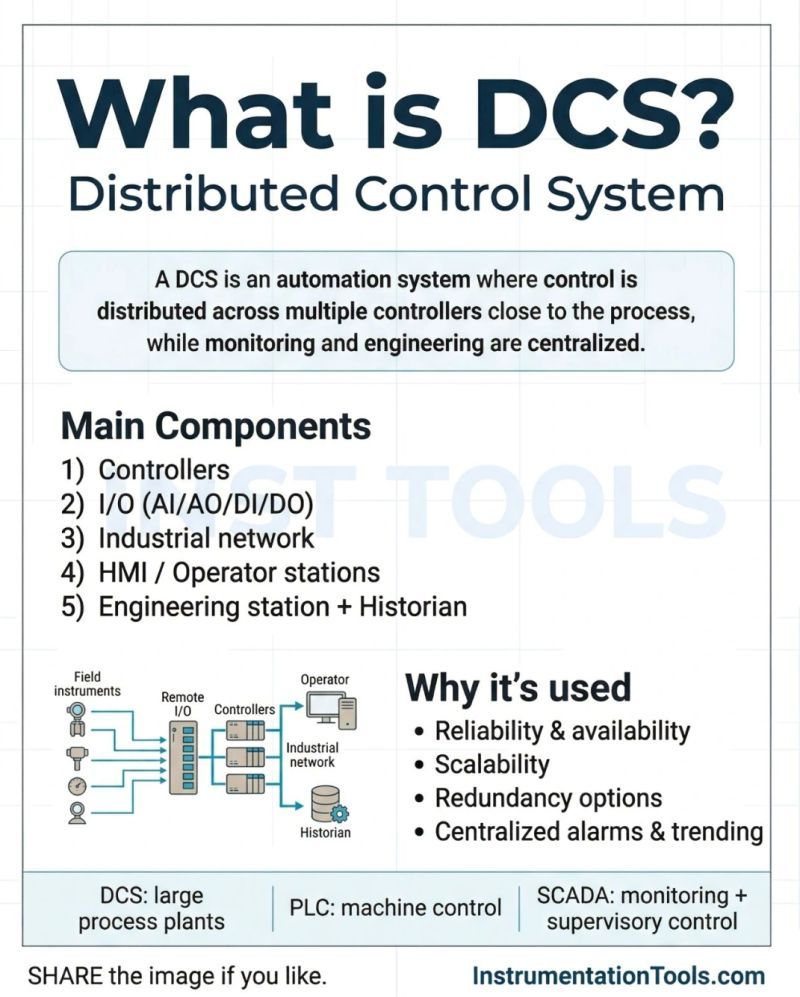
What exactly is a DCS?
Unlike a centralized system, a DCS distributes control across multiple controllers located close to the process. This architecture ensures that even if one part of the system faces an issue, the rest of the plant keeps running.
The 5 Core Pillars of DCS Architecture:
1️⃣ Controllers: The local “brains” executing complex logic.
2️⃣ I/O (AI/AO/DI/DO): The vital link to field instruments.
3️⃣ Industrial Network: The high-speed backbone for data flow.
4️⃣ HMI/Operator Stations: Centralized windows for real-time monitoring.
5️⃣ Engineering Station & Historian: Where logic is born and data is archived for long-term trending.
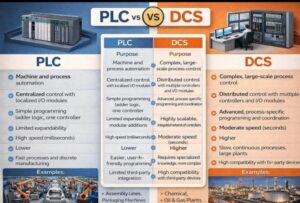
DCS vs. PLC/SCADA: The Quick Comparison ⚖️
🔹️ DCS: Best for large, continuous processes (Chemicals, Power, Oil & Gas). It offers a unified engineering environment and “out-of-the-box” redundancy.
🔹️ PLC/SCADA: Best for discrete machinery and modular systems. It offers high flexibility for custom architectures but often requires separate engineering for logic and visualization.
Plants rely on DCS because it maximizes High Availability and Redundancy. By centralizing alarms and monitoring while distributing control, operators can manage complex plant expansions seamlessly and respond to process deviations before they become downtime.
Are you seeing a shift toward more integrated DCS environments in your industry, or is the modularity of PLC/SCADA still the preferred choice? Let’s discuss in the comments! 👇