🔌 Industrial Communication Protocols Simplified, A Quick Guide for Engineers
In today’s automation world, a PLC (Programmable Logic Controller) is not just a controller; it’s the brain connecting machines, sensors, drives, and entire production systems. But how do all these devices communicate?
Here’s a simplified breakdown of the most widely used industrial communication protocols:
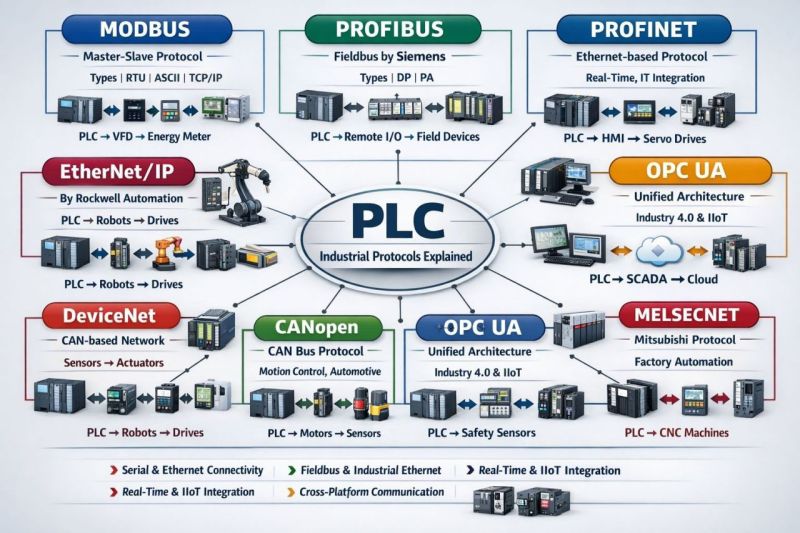
🔹 MODBUS
A classic master-slave protocol used in RTU, ASCII, and TCP/IP forms. Reliable and simple, commonly used for PLCs to VFDs and energy meters.
🔹 PROFIBUS
A robust fieldbus (DP/PA), which is widely used in process and factory automation. Ideal for PLCs communicating with remote I/O and field devices.
🔹 PROFINET
An Ethernet-based evolution of PROFIBUS enabling high-speed, real-time communication and seamless IT integration.
🔹 EtherNet/IP
Popular in Rockwell ecosystems. Used for connecting PLCs with robots, drives, and distributed systems.
🔹 DeviceNet
A CAN-based protocol designed for sensors and actuators—simple and cost-effective for lower-level communication.
🔹 CANopen
Another CAN-based protocol, which is widely used in motion control and automotive applications.
🔹 OPC UA
The backbone of Industry 4.0 and IIoT. Enables secure, platform-independent communication from PLC → SCADA → Cloud.
🔹 MELSECNET
Mitsubishi’s proprietary protocol, which is commonly used in factory automation and CNC systems.