➡️➡️ Understand in PLC programming timer and counter
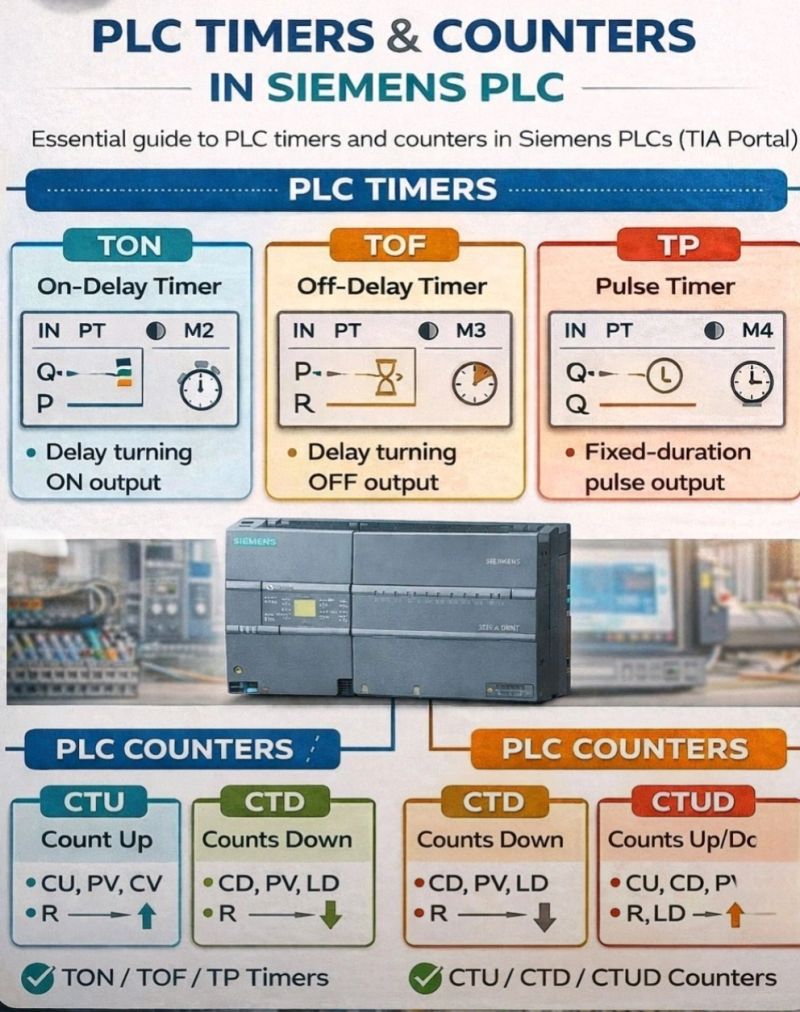
⏱️ What is a PLC Timer?
➡️ A PLC Timer is used to introduce a time delay in a control process.
When a condition becomes TRUE, the timer starts counting time, and after the preset time is completed, the output turns ON or OFF.
✅ Types of PLC Timers:-
➡️ON-Delay Timer (TON)
Output turns ON after the input remains ON for a preset time.
➡️OFF-Delay Timer (TOF)
Output remains ON for a preset time even after the input turns OFF.
➡️Retentive Timer (RTO)
Accumulated time is retained even if power is lost or the input turns OFF.
🔢 What is a PLC Counter?
➡️A PLC Counter is used to count events or pulses such as products, machine cycles, or operations.
✅ Types of PLC Counters:-
➡️Up Counter (CTU)
Counts upward from zero when input pulses are received.
➡️Down Counter (CTD)
Counts downward from a preset value.
Up/Down Counter (CTUD)
Can both increment and decrement the count value.
🏭 Practical Applications:
Conveyor belt delay control
Motor start/stop timing
Product and batch counting
Packaging and bottling systems
🔧 Conclusion:
Timers and Counters are fundamental building blocks of PLC programming.
Understanding them is essential for anyone working in industrial automation.