🔧What Are the Basic Components of a PLC System?
When people see a PLC panel, they often focus only on the PLC CPU. But a complete PLC system consists of several components working together to control industrial machines and processes.
Let’s explore the basic physical components of a PLC system.
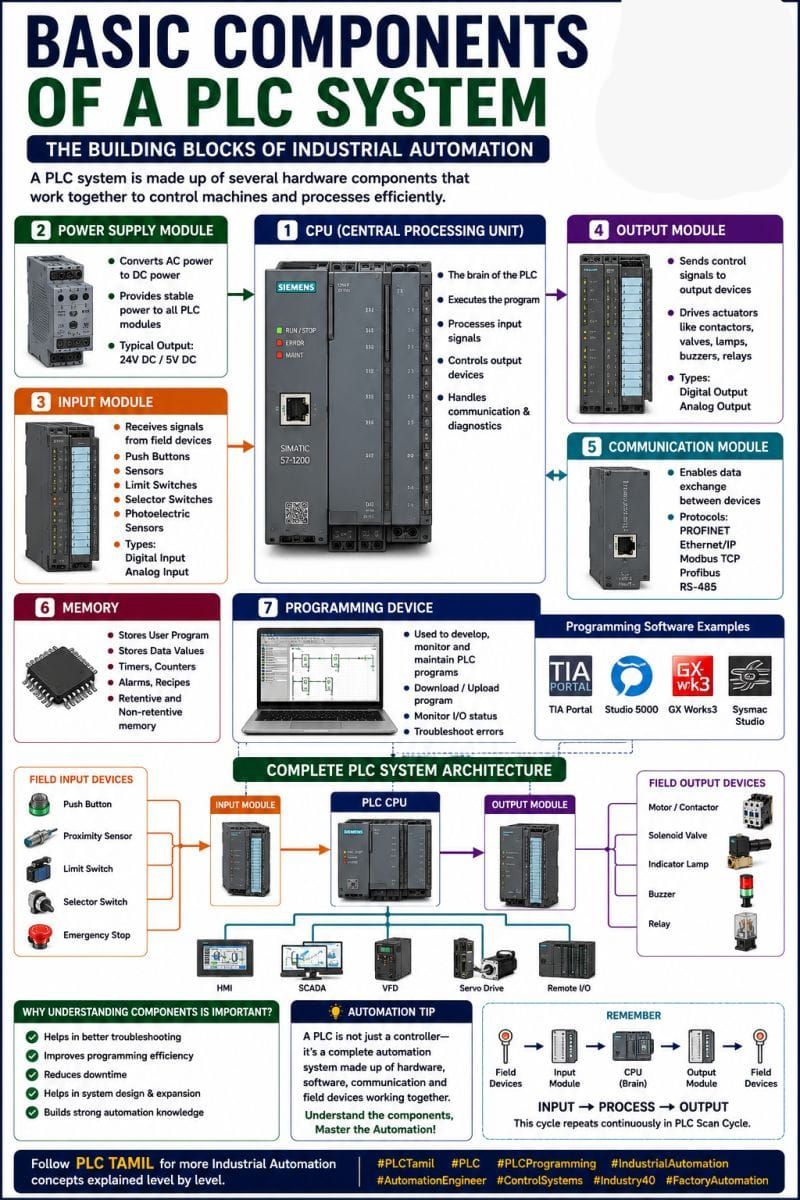
🧠 1. CPU (Central Processing Unit)
The CPU is the brain of the PLC.
✅ Executes the program
✅ Processes input signals
✅ Controls output devices
✅ Handles communication and diagnostics
Without the CPU, the PLC cannot function.
⚡ 2. Power Supply Module (SMPS)
The power supply converts AC voltage into the DC voltage required by the PLC.
Typical voltages:
24V DC
5V DC
12V DC
It provides stable power to all PLC modules.
📥 3. Input Module
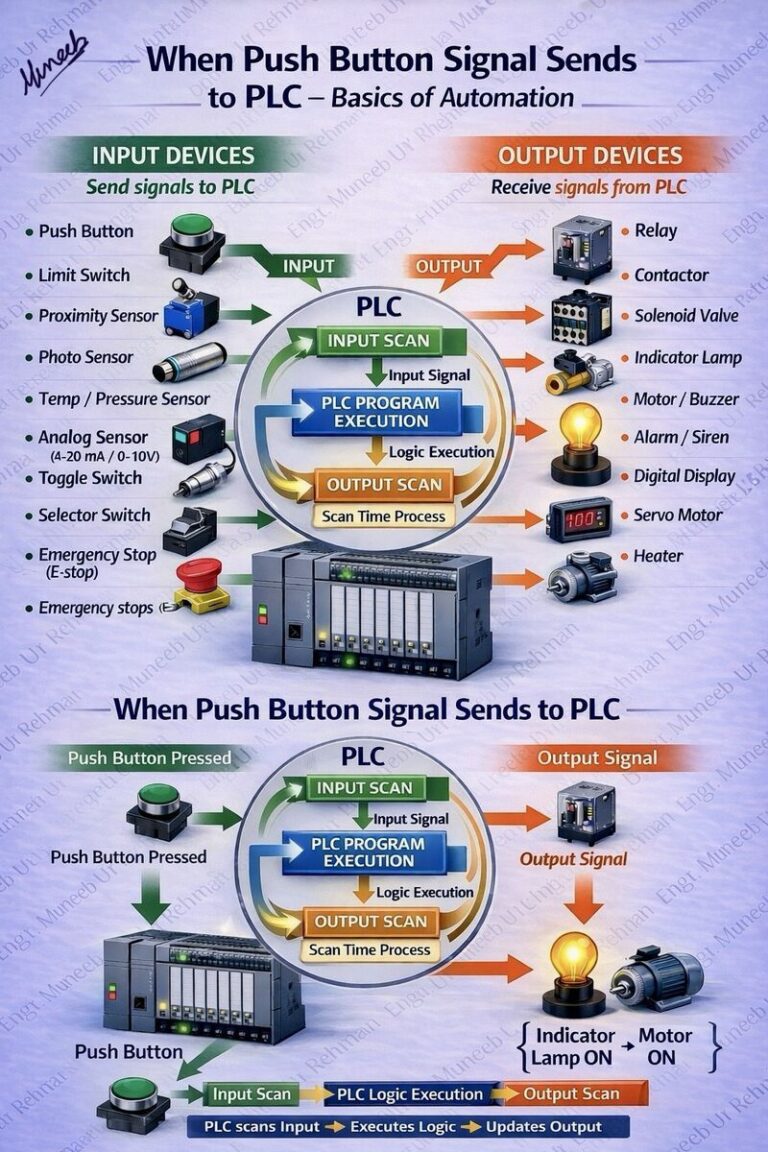
Input modules receive signals from field devices such as:
Push Buttons
Proximity Sensors
Limit Switches
Selector Switches
Photoelectric Sensors
These signals are sent to the CPU for processing.
📤 4. Output Module
Output modules send control signals to:
Contactors
Solenoid Valves
Indicator Lamps
Buzzers
Relays
The CPU decides when outputs should turn ON or OFF.
🌐 5. Communication Module
Used for data exchange between devices.
Common communication protocols:
PROFINET
Ethernet/IP
Modbus TCP
Profibus
RS-485
This module enables PLCs to communicate with HMIs, SCADA systems, VFDs, Servo Drives, and other PLCs.
💾 6. Memory
PLC memory stores:
User Program
Data Values
Timers
Counters
Alarms
Recipes
Memory can be retentive or non-retentive depending on the application.
🖥️ 7. Programming Device
A computer or laptop is used to:
✅ Create PLC programs
✅ Download logic to the PLC
✅ Monitor machine status
✅ Troubleshoot errors
Examples:
TIA Portal
Studio 5000
GX Works
Sysmac Studio
🏭 Complete PLC System Architecture
Field Devices → Input Module → CPU → Output Module → Field Devices
Additional devices:
HMI
SCADA
VFD
Servo Drive
Barcode Scanner
Remote I/O
All connected through industrial communication networks.
💡 Automation Tip
A PLC is not just a controller—it’s a complete automation system made up of hardware, software, communication, and field devices working together.
Understanding the physical components of a PLC system is the first step toward becoming a successful automation engineer.
Follow PLC TAMIL for more Industrial Automation concepts explained level by level.
hashtag#PLCTamil hashtag#PLC hashtag#PLCProgramming hashtag#IndustrialAutomation hashtag#Automatio